Bat-tholomew: The Bat, The Myth, The Legend
Before there was the Washburn CHAOS Lab, there was Bat-tholomew. This is the story of how one tiny hallway bat accidentally launched an interdisciplinary research program and became the Omen of CHAOS.
FERAL SCIENCEBATSLAB TRADITIONSBAT-THOLOMEW
Dr. Rachel Washburn
6/3/20263 min read
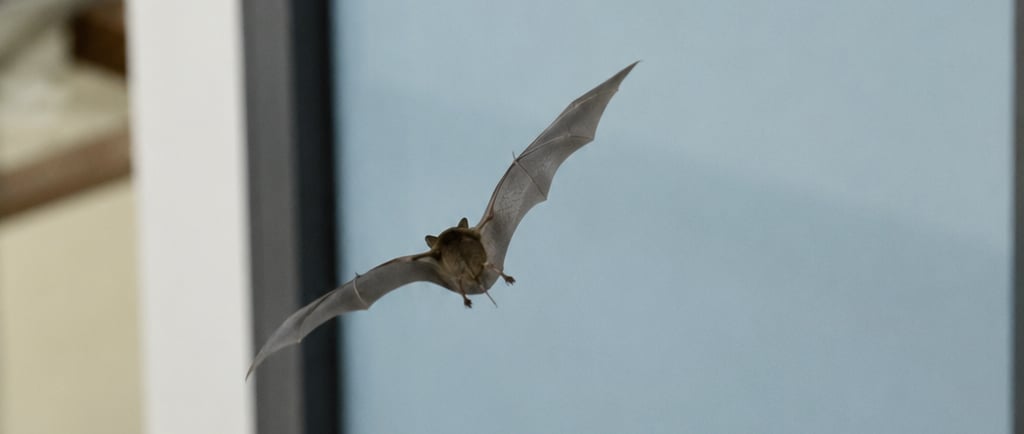
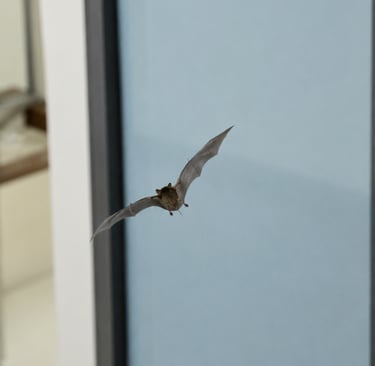
Bat-thomomew: The Omen of CHAOS.
Every lab has an origin story. Some begin with a groundbreaking discovery. Some begin with a mentor. Some begin with a research paper that changes everything. The Washburn CHAOS Lab began when a bat appeared.
The date was September 24, 2019. I was in the middle of my PhD in Biomedical Science. My life revolved around immunology, infectious disease, sterile laboratories, and clinical research. If you had asked me then where my career was headed, feral science would not have made the list.
My work wife and I were leaving one of the sterile immunology laboratories, and the moment we stepped out into the hallway, we were immediately blindsided by a sight that I can only describe as profoundly unexpected. A bat descended from the heavens.
Now, to be completely accurate, the heavens in question were an open ceiling tile. Nevertheless, an actual bat emerged from above and dropped into the middle of a sterile biomedical research building as though this was a perfectly normal thing for a bat to be doing. It was not. At least not in an immunology department. Being the first person to spot him, I exercised my sacred and unquestionable right to name him. I bequeathed unto him the honorable name of Bat-tholomew.
Now, I fully recognize that seeing a bat flying around a biomedical research building and immediately deciding it was an omen is not generally considered a rigorous scientific process. Nevertheless, standing there in that hallway, I became completely convinced that I needed to find a way to do cave research. I had no plan. I had no funding. I had no idea what that would even mean. I only knew that the thought had arrived and apparently intended to stay. What followed did not immediately involve caves. I finished my PhD and moved into a clinical postdoctoral fellowship. On paper, everything was proceeding according to plan. I followed the plan long enough to realize I hated the plan. It only took about three months.
At some point, after staring down the prospect of continuing along the carefully constructed trajectory I had spent years building, I finally asked myself a much more important question, “How in the actual hell do I make the cave thing happen?” The answer, as it turned out, was not "continue suffering and hope the situation improves." The answer was to stop pretending the idea was going to go away. So, I left that situation, I took a position as an assistant professor. I taught. I did research. Life moved forward. The bat, meanwhile, continued occupying valuable real estate in the back of my brain.
Then one day my husband pointed out that the Kentucky Geological Survey had been trying to hire someone to build a geohealth program. The problem was that they were looking for a geologist. I was not a geologist. I was a biomedical scientist with an immunology background, a persistent cave obsession, and apparently enough confidence to schedule a meeting anyway. What followed was a conversation that can best be summarized as, "You haven't found a geologist willing to learn health. What if you hired a health scientist willing to learn geology?" For reasons that still surprise me, they did not immediately throw me out of the building. Instead, they listened. Then I wrote a grant proposal. Then it got funded.
What began as an unconventional idea merging biomedicine and geoscience somehow became a laboratory dedicated to forcing multiple scientific disciplines to play nicely, tearing down gatekeeping, embracing the messy reality of natural systems, and involving the community in all of it. I don't think anyone involved in that original meeting was expecting the Washburn CHAOS Lab when I pitched the project. But that's what they got.
These days Bat-tholomew occupies a strange position somewhere between laboratory mascot, fieldwork spirit animal, and minor scientific cryptid. Tiny plush Bat-tholemews now travel to conferences, field sites, outreach events, caves, and classrooms. Somewhere along the way, a random hallway bat became the unofficial mascot of an interdisciplinary research program dedicated to asking what happens when geology, microbiology, chemistry, and medicine all collide in the same place. Every year on September 24th people send Bat-tholomew Day greetings as though this is an entirely normal holiday and not the result of a bat falling through a ceiling tile seven years ago.
Then again, the Washburn CHAOS Lab is built around the idea that the most interesting discoveries often begin with unexpected observations, unusual questions, and the willingness to follow curiosity somewhere completely unreasonable. In that sense, Bat-tholomew may be the most accurate representation of the lab we could possibly have asked for. The Washburn CHAOS Lab exists because one day a bat appeared where no bat should have been, and an idea arrived that refused to die.
Science is metal. Science is feral. Science is CHAOS.
Washburn CHAOS Lab
Science is metal. Science is feral. Science is CHAOS.
director@washburnchaoslab.com
#washburnchaoslab
© 2025. All rights reserved.
complex host and abiotic systems
@washburnchaoslab
Feral scientists exploring hostile systems, unstable environments, and the chemistry shaping what survives there.