
The Time We Accidentally Did Science in the Haunted Somerset Cave
We did not set out to investigate Somerset's haunted cave. We just accidentally picked the allegedly haunted room as our sampling site and proceeded to become significantly more interested in it.
FERAL SCIENCECAVE & KARSTFIELD WORKCURSED SCIENCEHAUNTED SITE
Dr. Rachel Washburn
5/27/20265 min read
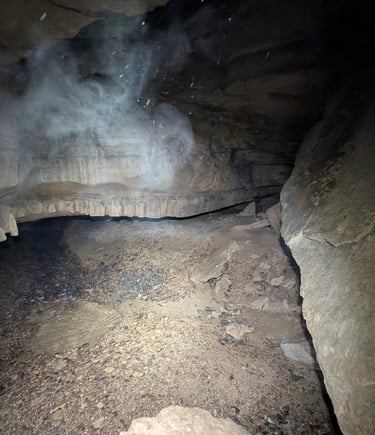
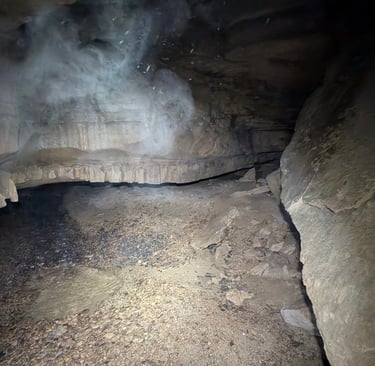
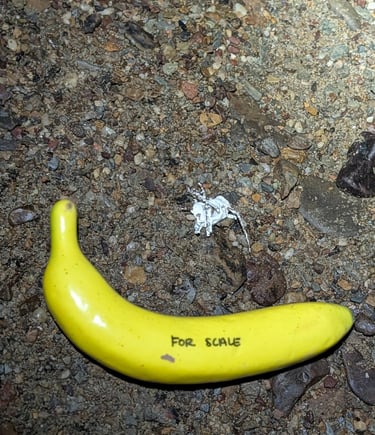
Yes, this is the allegedly haunted site we were sampling for completely legitimate interdisciplinary systems science. And yes, we use a banana for scale.
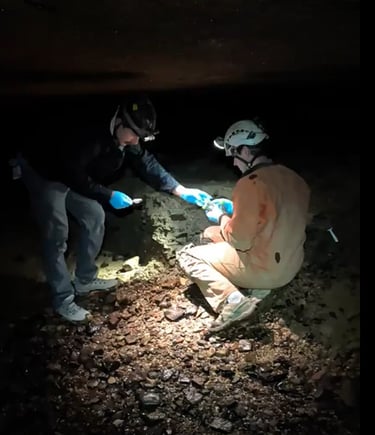
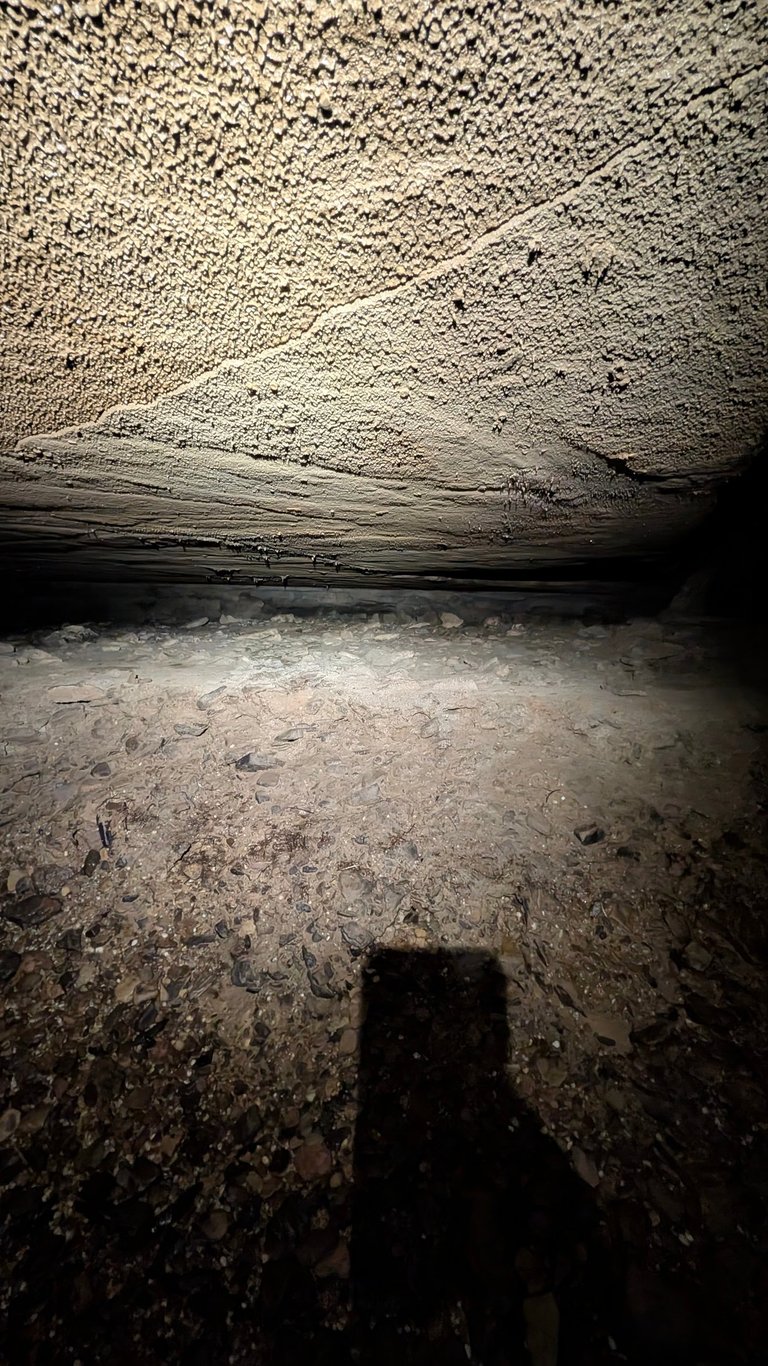
The cave came with bonus lore...
One of the things I have learned from spending an unreasonable amount of time crawling around underground is that caves are physically incapable of just being caves. Every cave has a story attached to it. Sometimes it's a historical story. Sometimes it's a geological story. Sometimes it's a story about somebody getting spectacularly lost in 1978 and becoming local legend. And apparently, sometimes it's a ghost story.
Earlier this month we discovered this while doing what we normally do in caves: wandering around getting excited about things most people wouldn't notice, taking atmospheric measurements, documenting conditions, recording observations, collecting samples, and generally behaving like a group of people who looked at darkness, mud, and confined spaces and thought, yes, this seems like an excellent way to spend a Saturday.
So we’re doing our preliminary walkthrough of the cave, looking for cool things to sample when we get to this hidden waterfall room. And man, this room was fantastic. Beautiful formations, active water movement, two waterfalls, even cave marshmallow fungi. The kind of place where scientists immediately start pointing at random walls and saying, "I want samples from that," without necessarily being able to explain why until several hours later. Which is exactly what happened.
At some point during all of this, somebody casually informed us that the room was allegedly haunted. Now, I need everyone to understand that this information did not have the effect they probably expected. A normal group might hear that and become concerned. A normal group might ask questions. A normal group might reconsider their life choices. Instead, we immediately became more interested. This is not a personality flaw. This is a business model.
The reality is that horror has been one of my favorite things for as long as I can remember. Ghost stories, monster movies, creepy folklore, abandoned places, weird legends, all of it. If you tell me a cave has a haunting attached to it, my reaction is not going to be, "We should leave." My reaction is going to be, "Excellent. Tell me everything."
We had managed to identify the allegedly haunted section of cave strictly through scientific curiosity before anyone informed us of this bonus content, which tracks. Because if there is a haunted cave in Kentucky, statistically speaking, the Washburn CHAOS Lab was probably going to end up in it eventually. Half our research sites already look like they belong in either a horror movie or a heavy metal album cover. We voluntarily disappear into caves, abandoned mines, sinkholes, karst systems, and places where normal people take one look and say, "Absolutely not." The cave having bonus lore feels less like an unexpected development and more like the universe finally understanding our brand.
Now look, I'm not saying the place is haunted or not haunted. Honestly, that's outside the scope of this study and would require an entirely different grant proposal. Somewhere out there is a funding agency willing to read a budget justification that includes cave scientists, ghost hunters, functioning EMF readers, and a line item asking whether anyone has contact information for the Winchester brothers, but I have yet to identify which agency that might be. Until then, we're going to have to leave the paranormal component of the cave unaddressed.
I will say this, though. In that particular area of the cave, our headlamps started acting weird. Not dead-battery weird, either. We all had fresh batteries and backup lamps because spending enough time underground teaches you very quickly that redundancy is not optional. Yet for whatever reason, several of the lights seemed determined to spend their time in that room randomly shutting off, flickering, or otherwise questioning their commitment to being headlamps. And yes, before anybody asks, I have video footage of it. You can find it on our social media. More interestingly, once we left that section of cave, the problem mysteriously stopped and everybody's lights went right back to behaving normally. Oooooooh. Spooky.
Is it slightly embarrassing that I spent part of the drive home looking through photographs hoping I'd accidentally captured a ghost? Probably. Did I find one? Unfortunately no. The photographs contained nothing but geology, hydrology, cave formations, water features, and microbial habitats. In fairness, I was equally excited about all of those things. One of the occupational hazards of becoming a cave scientist is that eventually you find yourself genuinely thrilled by a particularly interesting rock-water-microbe situation and have to accept that this is who you are as a person now. The ghosts, if present, unfortunately declined to appear in the dataset.
The thing I love about caves is that they're already halfway to supernatural before anybody starts adding folklore. You spend enough time underground and you start to appreciate just how strange these systems actually are. Entire ecosystems exist in darkness. Water carves landscapes nobody sees. Minerals build structures that look impossible. Microbes survive in conditions that would make most organisms immediately file a complaint. Weird chemistry happens constantly beneath our feet without asking anyone's permission. If somebody described caves in a fantasy novel, we'd probably accuse the author of trying too hard.
Then somebody adds a ghost story and suddenly the cave comes with downloadable content. Honestly, that's incredible value.
The samples are headed into the usual Washburn CHAOS Lab analytical pipeline now. We'll start figuring out who was living there, what environmental conditions they were dealing with, what chemistry was present, and how all the geology, atmosphere, water, microbes, and metabolites are interacting within the system. In other words, we're going to do exactly what we always do when confronted with a cave full of mysteries: collect data and ask increasingly strange questions until the cave starts giving us answers.
And if we happen to discover some novel metabolite from the allegedly haunted room, I want everyone to know right now that I will absolutely refer to it as a haunted metabolite for the remainder of my professional career. Not because it's scientifically accurate. Because some opportunities are simply too beautiful to waste.
Science is metal. Science is feral. Science is CHAOS.
Washburn CHAOS Lab
Science is metal. Science is feral. Science is CHAOS.
director@washburnchaoslab.com
#washburnchaoslab
© 2025. All rights reserved.
complex host-abiotic systems
@washburnchaoslab
Feral scientists exploring hostile systems, unstable environments, and the chemistry shaping what survives there.
#feralscience