
Brock's Cave
Pulaski County, Kentucky, USA
Why study Brock's Cave?
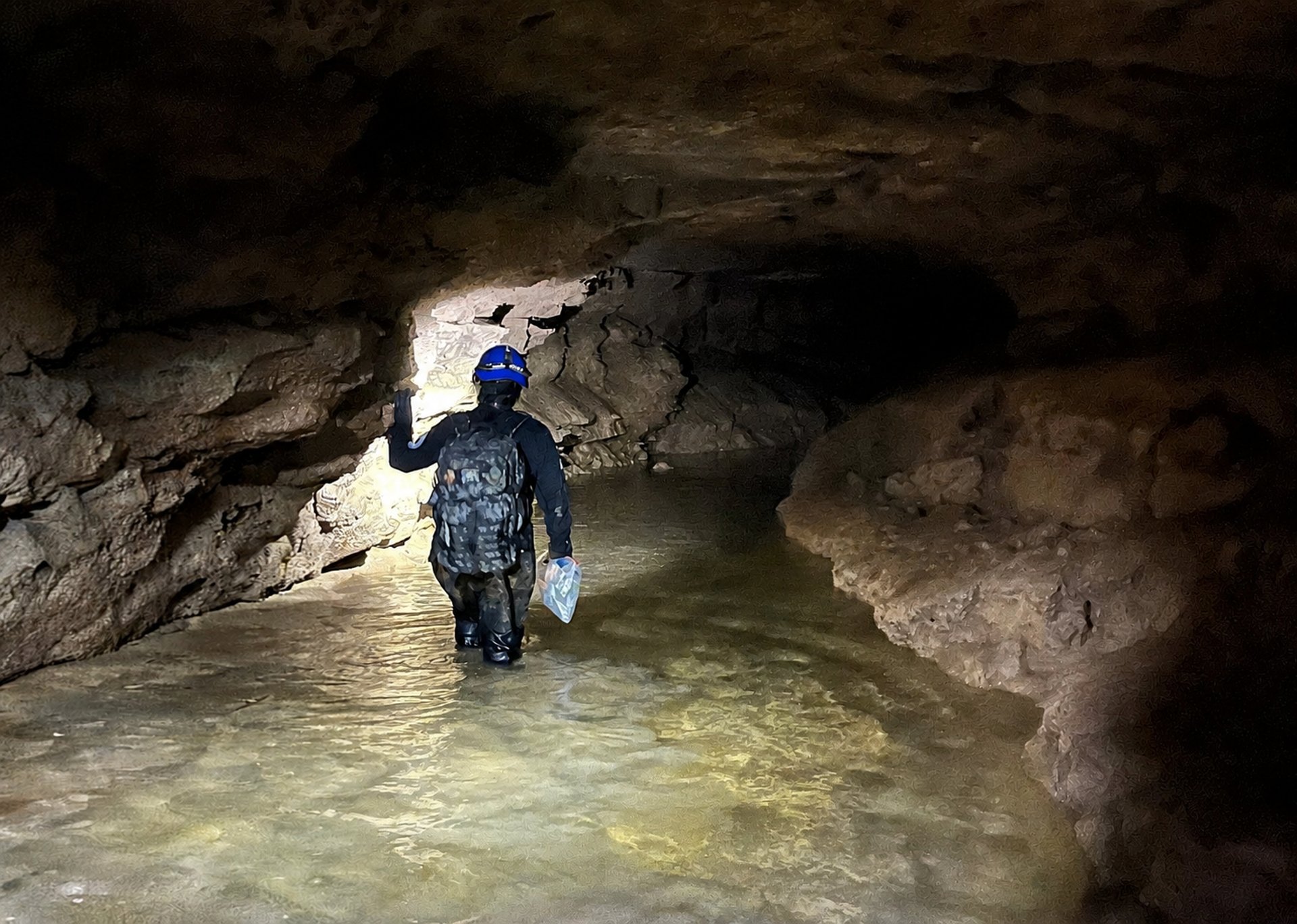
Brock’s Cave is privately owned, shallow, wet, muddy, prone to flooding, and absolutely packed with the kind of subsurface infrastructure people actually need down there: foundation settings, wells, pipes, casings, all of it sitting inside an active cave environment where water, rock, microbes, and built materials are sharing the same space whether anybody planned for that or not. It also has some seriously cool calcite concretions, which are not part of the infrastructure question, they’re just cool and we’re going to appreciate them accordingly.
We’re here because a friend who caves here told us about all that infrastructure, which immediately gave us a different question to start bothering the cave with. What biofilms have claimed residence on the things we build underground? What are they using those materials for, what compounds are they producing while they live there, and how much of that chemistry also happens to break down or alter the surfaces they’re growing on? The microbes are not plotting against the well casing. They’re just eating, growing, competing, building their own little microbial infrastructure, and some of the chemistry that makes that possible can also be pretty hard on ours.
So here we’re looking at what those communities are doing on built materials, what their own biofilm architecture looks like, what chemistry they’re deploying to make a living there, and whether that can help us get better at predicting microbially influenced degradation before it becomes a much more expensive problem. Because we need wells. We need foundations. We need pipes. And if microbes are going to move into that neighborhood too, we should probably know what they’re doing in there.


BRC_01_SPVC1
Surface Pipe
This is the part of the water well sticking out above the surface, which gives us something to compare everything underground against. Think of it as our surface control: same infrastructure, completely different neighborhood.


BRC_02_CPVC1
Cave Pipe 1
Here’s that same PVC water well, now underground and sitting nice and pretty in the vadose zone, that part of the underworld where groundwater and air share the space. The well runs straight through it, so we want to know who’s living on it down here and whether those microbes are playing nice with the infrastructure or getting up to anything nefarious.


BRC_03_CSBP
Cave Black Pipe
We’ve also got black piping coming down from the surface, and this one brought a metal backflow preventer along for the ride. That gives us another material to poke at and see whether adding metal changes who moves in, what they’re making, and what they’re doing to the infrastructure while they’re there.


BRC_04_CPVC2
Cave Pipe 2
A couple hundred feet deeper into the cave, near a whole lot more flowing water, we spotted another well. So now we have questions: do the microbes, minerals, and metabolites look like what we found at the other well, or is a couple hundred feet and a change in water movement enough to give us a completely different neighborhood?


Who Made This Possible
Access and Site Partners
Anonymous Landowner
Isaac Huffman, Cave Guide
This work is not a single step and it is not a single person. It starts with people who make access possible, continues with those willing to get into the field and collect the samples, and runs all the way through the lab, the analysis, and the work required to turn raw material into something that holds up.
By the time you are looking at data, figures, or publications, it has already moved through a chain of people who showed up and did the work at every stage. We do not take that for granted. Thank you.
Washburn CHAOS Lab Members
Dr. Rachel Washburn, Director, Washburn CHAOS Lab
Dr. Alex Washburn, Geochemist, CONAN Division, KGS
Field Sampling
Jacob Ray, Citizen Scientist
Dr. Alex Washburn, Geochemist, CONAN Division, KGS
Dr. Rachel Washburn, Director, Washburn CHAOS Lab
Sample Analyses Collaborators
Jason Backus, Laboratory Manager, KGS
Andrea Conner, Laboratory Analyst, KGS
Funding and Sponsorship
University of Kentucky OVPR Postdoctoral Research Fellowship
KGS Enrichment Fund
Photography, Videography, and Imaging
Dr. Alex Washburn, Geochemist, CONAN Division, KGS
Dr. Rachel Washburn, Director, Washburn CHAOS Lab
Get in touch
If you have questions about this system, start there. If you want to get involved, use these data as a starting point, get access to raw datasets, collaborate, have us collect samples, or come in and run your own study, this is where that happens. This work is open to people who are actually going to do something with it. The form is below.
Washburn CHAOS Lab
Science is metal. Science is feral. Science is CHAOS.
director@washburnchaoslab.com
#washburnchaoslab
© 2025. All rights reserved.
complex host-abiotic systems
@washburnchaoslab
Feral scientists exploring hostile systems, unstable environments, and the chemistry shaping what survives there.
#feralscience