
Diamond Caverns
Cave City, Kentucky, USA
Why study Diamond Caverns?
Diamond Caverns is a show cave near Cave City, Kentucky, with a beautiful tour route, a ton of cave history, and plenty of stalactites, stalagmites, cave popcorn, and other geology doing exactly what caves do best. If you're in the area, go check them out. The guides know their stuff, the cave is gorgeous, and the gift shop is dangerously effective if you already have a rock problem.
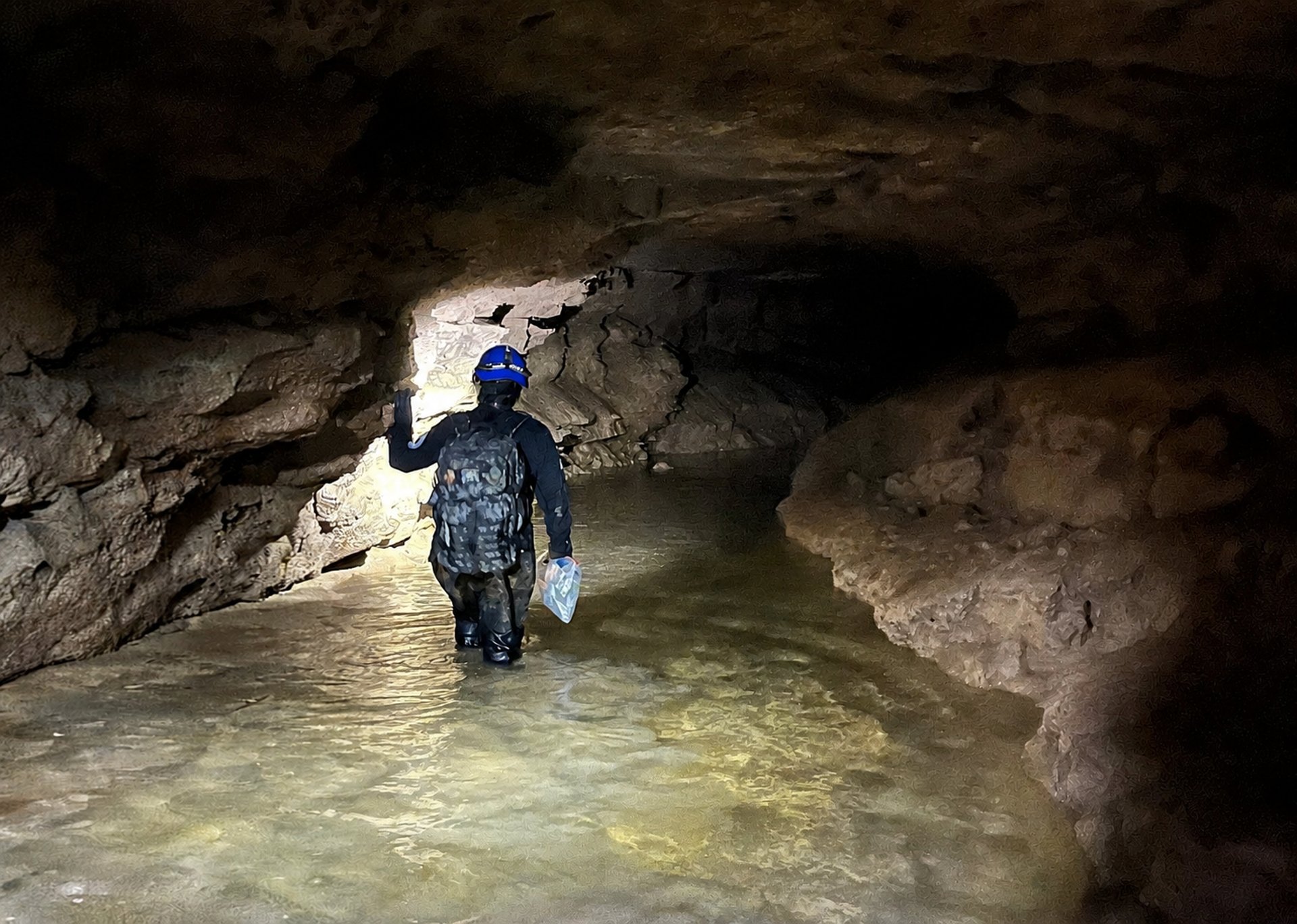
One of our team members used to guide here and came back to measure methane concentrations throughout the cave, which gave us a very good excuse to come along and start asking more questions. Show caves are useful because people are actively part of the system. There are lights, pathways, tours, cleaning, maintenance, and constant movement through the space, and all of that gives us a chance to look at what changes when a cave gets used regularly. Maybe some of those changes are a problem. Maybe some aren't. We don't know yet, which is kind of the whole point.
So we're comparing lit parts of the tour route, unlit parts of the tour route, and unlit areas completely off the tour route to see how the microbes, chemistry, and cave environment shift across them. We're also looking at why methane concentrations differ from one part of the cave to another and what's happening with lampenflora wherever the lights have given photosynthetic organisms a foothold underground.


DC_01_SP Shimmering Pond
This pool was full, active, and getting absolutely pelted with drip water from the stalactites above it. It sits just off the show route, so we grabbed the water and the sediment beside it to see what’s going on in a spot where standing water, fresh drip input, and cave sediment are all part of the same little system.


DC_02_FT Fishtail
This one was extremely scientific. We took turns standing under a giant dripping stalactite with a cup until we had enough freshly dripped cave water to sample. It drips straight onto the tour route, and now we can compare what’s coming directly through the rock with what’s sitting in the pool nearby.


DC_03_BC Bridal Chamber
The Bridal Chamber is one of the iconic stops on the Diamond Caverns tour route, and people have actually gotten married down here, so the name is doing exactly what it says on the tin. The atmosphere in this part of the cave was a little different from the others, which means now we want to know what else changed with it.


DC_04_STN Stairs to Nowhere
Our Speleofest Citizen Scientists found this weird white powder on the cave wall in Saltpeter Cave, and we couldn't confidently explain what it was. It came back to the lab with us, where we're working to figure out exactly what we're looking at.


DC_05_SC Sandy Crawl
This is the very end of the tour route, which gives us another point in the show cave system to compare against the beginning. Same cave, same general route, different location, and now we get to see how much that actually matters.


DC_06_LF Lampenflora
We had to grab some lampenflora while we were here. These photosynthetic little communities move into lit parts of caves, and we want to know whether they build the same kind of community everywhere or if the cave, the minerals, and the local conditions change who shows up and what they’re doing.


DC_07_CM01 Cave Marshmallow
Cave marshmallow. Cave crickets can get infected with fungi that cover them in white growth, and in cave humidity it can look way more like marshmallow fluff than fuzzy mold. We are absolutely interested in that whole situation, and cave marshmallow is a normal part of cave ecosystems, so nobody needs to worry about the crickets starting the apocalypse.


Who Made This Possible
Access and Site Partners
Louisville Grotto
Nicholas Belen, Cave Guide
This work is not a single step and it is not a single person. It starts with people who make access possible, continues with those willing to get into the field and collect the samples, and runs all the way through the lab, the analysis, and the work required to turn raw material into something that holds up.
By the time you are looking at data, figures, or publications, it has already moved through a chain of people who showed up and did the work at every stage. We do not take that for granted. Thank you.
Washburn CHAOS Lab Members
Dr. Rachel Washburn, Director, Washburn CHAOS Lab
Dr. Alex Washburn, Geochemist, CONAN Division, KGS
Victoria Apostolides, Student Volunteer Researcher, Appalachian State
Laura Hamann, Citizen Scientist
Field Sampling
Victoria Apostolides, Student Volunteer Researcher, Appalachian State
Finley Gardner, Potter Intern 2025, KGS
Laura Hamann, Citizen Scientist, Washburn CHAOS Lab
Madison High, Geologist I, KGS
Hala Ison, Potter Intern 2025, KGS
Maddie Parker, Potter Intern 2025, KGS
June Stone, Potter Intern 2025, KGS
Dr. Alex Washburn, Geochemist, CONAN Division, KGS
Dr. Rachel Washburn, Director, Washburn CHAOS Lab
Emmerson Willhoite, Potter Intern 2025, KGS
Sample Analyses Collaborators
Jason Backus, Laboratory Manager, KGS
Andrea Conner, Laboratory Analyst, KGS
Sahar Mofidi, Graduate Student, Tidgewell Lab, University of Kentucky
Funding and Sponsorship
University of Kentucky OVPR Postdoctoral Research Fellowship
KGS Enrichment Fund
Photography, Videography, and Imaging
Nicholas Belen, Cave Guide, Louisville Grotto
Laura Hamann, Citizen Scientist
Dr. Alex Washburn, Geologist III, KGS
Dr. Rachel Washburn, Director, Washburn CHAOS Lab
Get in touch
If you have questions about this system, start there. If you want to get involved, use these data as a starting point, get access to raw datasets, collaborate, have us collect samples, or come in and run your own study, this is where that happens. This work is open to people who are actually going to do something with it. The form is below.
Washburn CHAOS Lab
Science is metal. Science is feral. Science is CHAOS.
director@washburnchaoslab.com
#washburnchaoslab
© 2025. All rights reserved.
complex host-abiotic systems
@washburnchaoslab
Feral scientists exploring hostile systems, unstable environments, and the chemistry shaping what survives there.
#feralscience