
Fossil Cave
Pulaski County, Kentucky, USA
Why study Fossil Cave?
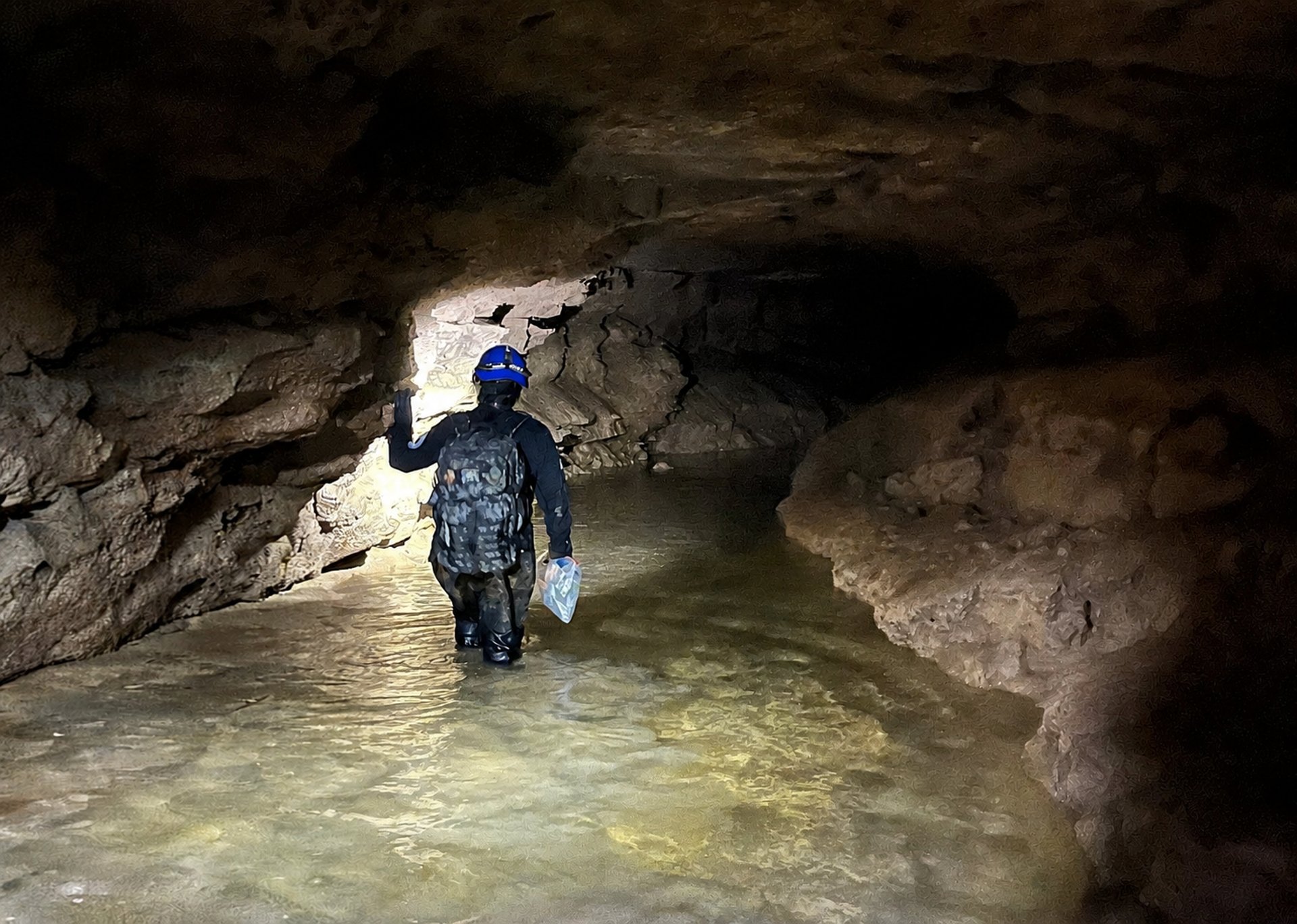
Fossil Cave is on private land, and the landowner is awesome and lets us come out and poke around his cave for science. Very few people have ever been inside, maybe a handful, so we have a cave here that hasn't had a ton of human traffic through it. There's a stream running through it, cave crickets everywhere, and we found bats, which are awesome and were left completely alone because we do not bother the bats. We also found more of that yellow mineral powder we've seen at Diamond Caverns, plus a few other mineral powders that we haven't seen at our other sites. So those are absolutely getting investigated.
There's also this hidden section with two waterfalls coming down from the ceiling into a pool, with sediment, mineral deposits, and cave marshmallow all around it. There was way too much happening in one spot to walk away from that, so we sampled the water, sediment, and cave marshmallow and started adding questions to the list. Then my headlamp started flickering on and off while we were in there. Okay, headlamps do that. Maybe the battery didn't charge all the way. Except when we left that area, it worked perfectly fine again.
Later we found out that particular waterfall area is rumored to be haunted. Nobody told us this before we sampled it. So we accidentally sampled a rumored haunted section of a cave because the geology and biology looked cool, which is pretty much exactly how I would expect this lab to end up investigating a haunted cave. Maybe there's something going on with the geology that can mess with a headlamp. Maybe the timing was just spectacular. Maybe we're about to discover a spectral biofilm. We have samples. Let's find out.


FOS_01_CG
There were a bunch of cave crickets in this part of the cave, and we found a nice pile of cricket guano sitting up on a ledge near the stream. The ledge was slightly less convenient when you're short, but I got up there and we got the sample. Now we're gonna see what microbes, metabolites, and chemistry come along with that much concentrated cricket activity.


FOS_02_YP
Same general area, and this time we found a whole lot more of that yellow powder we keep seeing in caves. We still don't know exactly what it is, whether we're looking at something mineralogical, microbial, or some combination of both. We've got enough of it now to start asking considerably more invasive questions.


FOS_03_WP
Then there was white powder all along sediment by the cave wall, because apparently this little section wasn't done giving us things to sample. Fossil Cave has a history of saltpeter, so that's one possibility sitting on the table. We grabbed it to figure out what the material actually is and who's living in it.


FOS_04_CAS
With all these powders sitting around, we needed some visually plain sediment from the same area. That gives us something from the same environment to put next to everything else and ask if those very obvious differences on the surface actually show up in the microbes, metabolites, and geochemistry.


FOS_05_HWF
This is the allegedly haunted waterfall area. We collected water straight from the waterfall by literally standing underneath it with collection tubes, then grabbed sediment from the crawl below. All of this happened while our headlamps were flickering, because apparently we couldn't just collect a normal waterfall sample and go home. Something interesting is going on here though, and we're gonna science it into submission.


FOS_06_CM
Cave marshmallow! These are little white, squishy biofilm blobs we keep finding growing on cave surfaces, and we found one sitting right in the haunted waterfall area, so obviously that came home with us too. We're finding these things in caves all over the place now, which gives us a really good question: are we finding similar microbial communities building the same structure in different caves, or does every cave have its own version of marshmallow?


Who Made This Possible
Access and Site Partners
Anonymous Landowner
Isaac Huffman, Graduate Student, Department of Pharmaceutical Sciences, University of Kentucky
This work is not a single step and it is not a single person. It starts with people who make access possible, continues with those willing to get into the field and collect the samples, and runs all the way through the lab, the analysis, and the work required to turn raw material into something that holds up.
By the time you are looking at data, figures, or publications, it has already moved through a chain of people who showed up and did the work at every stage. We do not take that for granted. Thank you.
Washburn CHAOS Lab Members
Dr. Rachel Washburn, Director, Washburn CHAOS Lab
Dr. Alex Washburn, Geochemist, KGS | CONAN Division, WCL
Field Sampling
Cole Huffman, Physician
Isaac Huffman, Graduate Student, Department of Pharmaceutical Sciences, University of Kentucky
Dr. Rachel Washburn, Director, Washburn CHAOS Lab
Sample Analyses Collaborators
Jason Backus, Laboratory Manager, KGS
Andrea Conner, Laboratory Analyst, KGS
Dr. Alex Washburn, Geochemist, KGS | CONAN Division, WCL
Funding and Sponsorship
University of Kentucky OVPR Postdoctoral Research Fellowship
KGS Enrichment Fund
Photography, Videography, and Imaging
Cole Huffman, Physician
Isaac Huffman, Graduate Student, Department of Pharmaceutical Sciences, University of Kentucky
Dr. Rachel Washburn, Director, Washburn CHAOS Lab
Get in touch
If you have questions about this system, start there. If you want to get involved, use these data as a starting point, get access to raw datasets, collaborate, have us collect samples, or come in and run your own study, this is where that happens. This work is open to people who are actually going to do something with it. The form is below.
Washburn CHAOS Lab
Science is metal. Science is feral. Science is CHAOS.
director@washburnchaoslab.com
#washburnchaoslab
© 2025. All rights reserved.
complex host-abiotic systems
@washburnchaoslab
Feral scientists exploring hostile systems, unstable environments, and the chemistry shaping what survives there.
#feralscience