
Edmonson Cave
Edmonson County, Kentucky, USA
Why study Edmonson Cave?
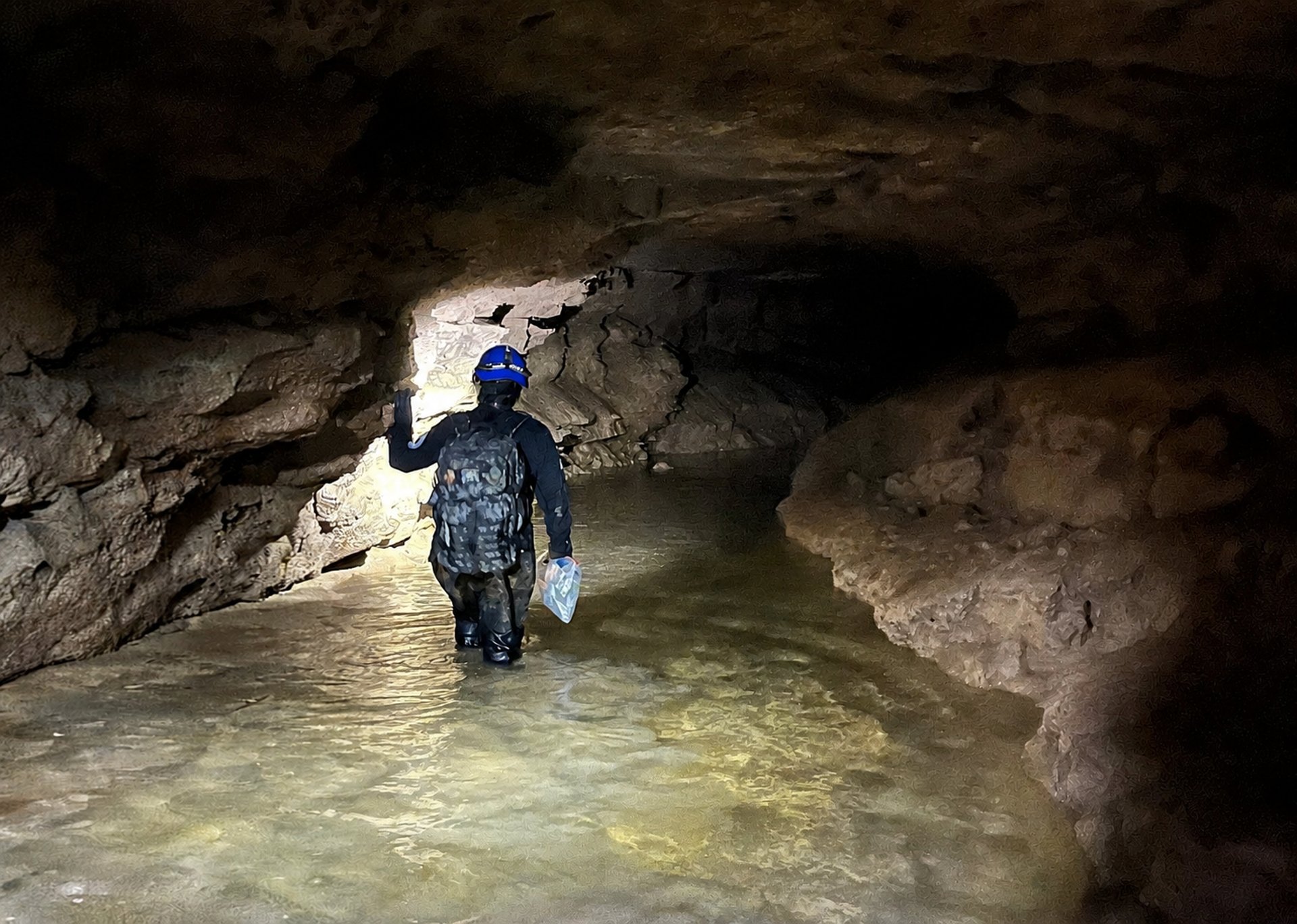
Edmonson Cave gave us a LOT to work with. There are different mineral colors and textures all over the place, moonmilk, biofilms, sediment, water moving through the system, and plenty of spots where you can actually see the geology and biology doing something together. We sampled across those differences because looking similar doesn't mean behaving similar, and looking completely different doesn't necessarily mean the biology underneath is different either. We want to know what's actually happening there.
Then there's a well intersecting the cave, which gives us a completely different kind of interface to poke at. Now we've got steel sitting underground long enough for the cave to start growing on it, with the surrounding sediment and rock right there to compare against it. Biofilm on the casing, microbes in the sediment, mineral deposits around both. There's a whole little system sitting around something humans shoved through the cave.
So we're working with mineral deposits, moonmilk, biofilms, sediment, and a lot of things we're still trying to identify. That's pretty much why Edmonson Cave immediately went onto the list of places we want to keep coming back to. There's too much happening here to get from one round of sampling.


ECA_01_PS Passage Sediment
Sediment had piled up along one of the main passages, except this wasn't just standard brown cave dirt. There were streaks of purple coloration running through it, so naturally some of that went into a sample tube. We want to know what's making it purple and whether that difference shows up in the minerals, microbes, or both.


ECA_02_BG Old Bat Guano
We found a small pile of old bat guano with no bats anywhere around it, so we threw on masks and collected some. White-nose syndrome is still a problem, nobody wants histoplasmosis, and bats are awesome, so there's plenty to investigate in the microbial communities they leave behind. And no, we don't disturb bats to get samples.


ECA_03_MM1 Moonmilk
Moonmilk is basically geology and microbiology making a cave formation together, so obviously we're interested. It's a soft speleothem with a whole microbe-mineral system happening inside it, and this one fluoresced bright aqua blue under 365 nm UV. Yeah, we're going to need to know what's doing that.


ECA_04_CG Cricket Guano
There were cave crickets everywhere, which means there was also plenty of cricket guano. Guano is a pretty concentrated little package of nutrients, microbes, and metabolites coming into a nutrient-limited cave, so we grabbed some. Maybe there's new chemistry hiding in there, and it also gives us another way to start following nutrient flow through the cave.


ECA_05_SCP Small Crawl
We grabbed sediment from a small, very tight crawl and found these black, shiny substances showing up both in the sediment and on a nearby speleothem. We don't know what they are yet. Mineral, microbial, some combination of the two? That's why they're in a tube now.


ECA_06_OWC Well Casing
A plugged oil well intersects the cave right in a narrow section of crawl, which meant I had to get in there and sample it despite every claustrophobic instinct telling me this was a terrible idea. We don't fully understand what happens when underground infrastructure sits in direct contact with cave microbes and biofilms for years, especially when you start asking what those communities might be doing to the material itself. So I got the sample.


ECA_07_MM2 Well Moon Milk
This one immediately gave us more questions. We found moonmilk right at the well casing, and under 365 nm UV it fluoresced the same bright aqua blue as the moonmilk elsewhere in the cave. Except this one ALSO fluoresced orange. Why? What's different here? Is it the microbial community, the mineralogy, something coming from the casing or plugged well? We have absolutely no idea yet, and that's exactly what we want to find out.


ECB_01_BGU Bat Guano/Urine
More old guano here, plus bat urine, with no bats present while we sampled. Same masks, same careful collection, same rule that we don't bother the bats. These samples give us another look at the microbial communities associated with bats and their roosting areas, especially as we try to understand what those communities look like where white-nose syndrome is present and where it isn't.


ECB_02_EGS Green Coating
We found green coloration growing on rock where a little daylight makes it into the cave, and it was only showing up on the surfaces facing that light. That's a pretty damn specific pattern. Something is taking advantage of that little bit of energy making its way underground, and we want to know who's doing it and what that community looks like.


Who Made This Possible
Access and Site Partners
Anonymous Partner
This work is not a single step and it is not a single person. It starts with people who make access possible, continues with those willing to get into the field and collect the samples, and runs all the way through the lab, the analysis, and the work required to turn raw material into something that holds up.
By the time you are looking at data, figures, or publications, it has already moved through a chain of people who showed up and did the work at every stage. We do not take that for granted. Thank you.
Washburn CHAOS Lab Members
Sarah Gilbert, Undergraduate Researcher, Washburn CHAOS Lab
Dr. Alex Washburn, Geochemist, KGS | CONAN Division, WCL
Dr. Rachel Washburn, Director, Washburn CHAOS Lab
Field Sampling
Sarah Gilbert, Undergraduate Researcher, Washburn CHAOS Lab
Madison High, Geologist, KGS
Zachary Walton, Geologist, KGS
Dr. Alex Washburn, Geochemist, KGS | CONAN Division, WCL
Dr. Rachel Washburn, Director, Washburn CHAOS Lab
Sample Analyses Collaborators
Jason Backus, Laboratory Manager, KGS
Andrea Conner, Laboratory Analyst, KGS
Sahar Mofidi, Graduate Student, Tidgewell Lab, University of Kentucky
Dr. Alex Washburn, Geochemist, KGS | CONAN Division, WCL
Funding and Sponsorship
University of Kentucky OVPR Postdoctoral Research Fellowship
KGS Enrichment Fund
Photography, Videography, and Imaging
Zachary Walton, Geologist, KGS
Dr. Alex Washburn, Geochemist, KGS | CONAN Division, WCL
Dr. Rachel Washburn, Director, Washburn CHAOS Lab
Get in touch
If you have questions about this system, start there. If you want to get involved, use these data as a starting point, get access to raw datasets, collaborate, have us collect samples, or come in and run your own study, this is where that happens. This work is open to people who are actually going to do something with it. The form is below.
Washburn CHAOS Lab
Science is metal. Science is feral. Science is CHAOS.
director@washburnchaoslab.com
#washburnchaoslab
© 2025. All rights reserved.
complex host-abiotic systems
@washburnchaoslab
Feral scientists exploring hostile systems, unstable environments, and the chemistry shaping what survives there.
#feralscience